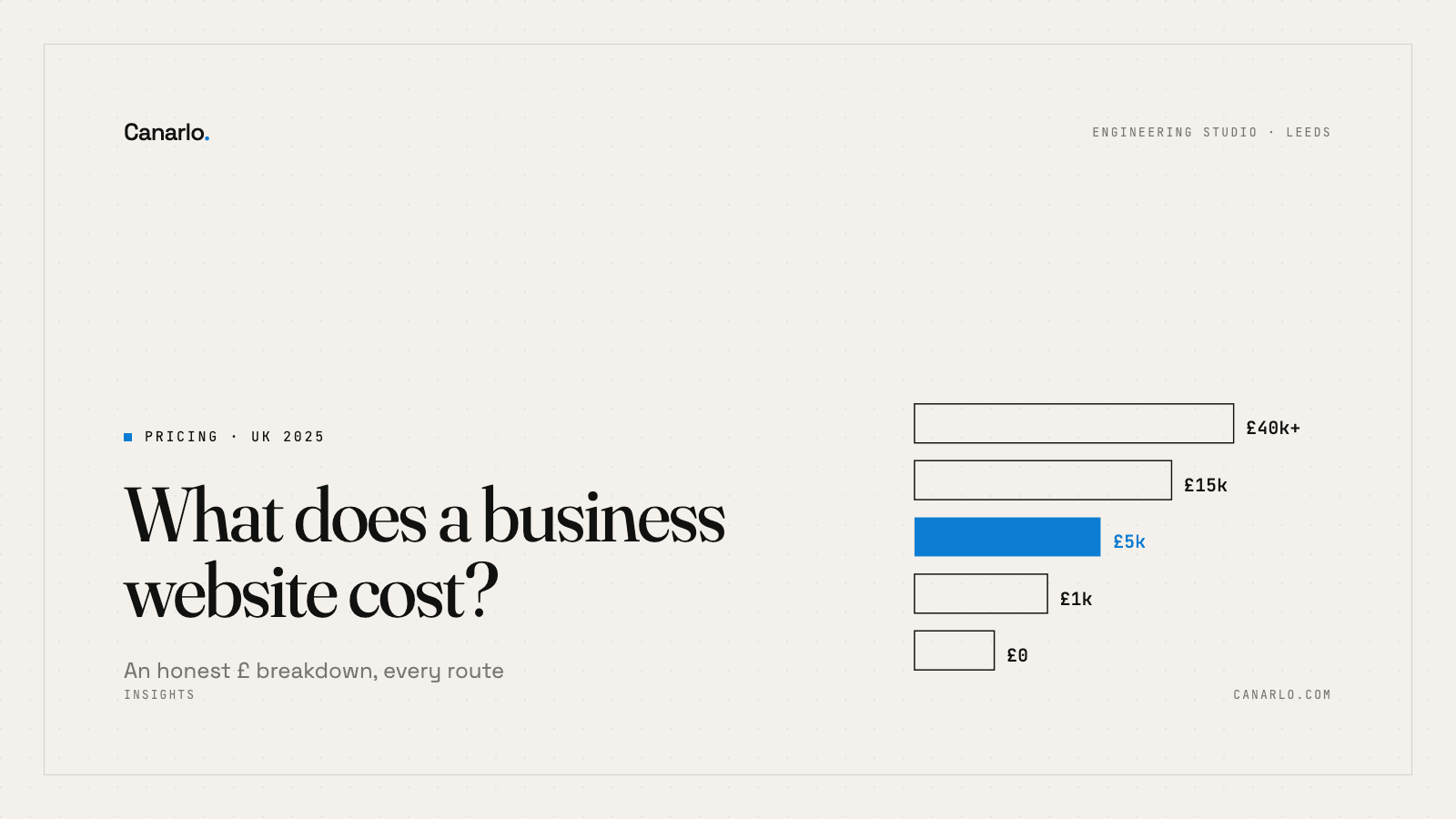
A business website in the UK costs anywhere from nothing to £100,000+. That range is useless to you, so here's a more honest breakdown by route — what you actually get, what you're trading away, and where hidden costs appear later.
The four routes, with real numbers
1. Free or DIY template (£0–£500/year)
Tools like Wix, Squarespace, and WordPress.com let you build something yourself. The templates are decent. If you can put in a weekend and have a clear head for copy, you'll have something live.
What you get: A basic web presence. Works for a sole trader who needs a credible-looking contact page.
What you trade away: Time (more than you expect), distinctiveness (your competitor used the same template), SEO performance (platform-level constraints), and flexibility (every customisation becomes a fight).
Hidden costs: £10–40/month in subscription fees, domain and email, and the hours you spend maintaining it yourself. Over three years, that adds up to £1,500–£3,000 in real money and probably 80+ hours.
2. Webflow / Squarespace professional build (£1,500–£4,000)
You hire a freelancer who's specialised in Webflow or a comparable visual builder. They set it up, populate it, and hand it over. If the freelancer is good, the site looks sharp and loads fast.
What you get: A polished, well-structured marketing site. Easier for you to edit than a custom build. Good for most small businesses.
What you trade away: You're tied to the platform. Webflow's pricing scales with traffic and team members — at £36–80/month at current plans. If the platform raises prices or discontinues features (it happens), you're stuck. You own the content, not the infrastructure.
Hidden costs: Monthly subscriptions indefinitely, and the cost of migrating if you outgrow it or the platform changes terms.
3. Bespoke design, CMS-backed (£4,000–£12,000)
This is what a studio like Canarlo builds at the entry tier. A custom design (not a template), built on a proper codebase (typically Next.js), with a content management system so you can update pages without a developer. SEO-optimised from the ground up.
What you get: A site that is genuinely yours. The design reflects your brand. The code is clean and maintainable. A developer who's never worked with you before can pick it up.
What you trade away: Time. A proper build takes four to eight weeks. You'll need to put thought into copy, images, and what the site needs to do.
Hidden costs: Hosting (typically £20–80/month depending on traffic), and occasional development time for larger changes.
4. Custom web application (£12,500–£50,000+)
When your site needs to do something — client logins, bookings, dynamic pricing, complex forms that feed a database — you're building a web app, not a marketing site. Different scope entirely.
This is outside the scope of this article. If that's what you need, the MVP guide is more relevant.
What Canarlo's £5k entry point includes — and excludes
At around £5k, here's what you're getting:
Included:
- Discovery session to map the site structure and goals
- Custom design (no templates)
- Up to 8–10 pages
- CMS for content updates
- SEO fundamentals: meta tags, canonical URLs, structured data, sitemap
- Responsive across mobile and desktop
- Hosted on Vercel (fast, reliable, included in the first three months)
- Code ownership — you get the repository
Not included:
- Copywriting (though we can recommend people)
- Professional photography
- Ongoing monthly updates unless agreed separately
- E-commerce (Shopify or a custom cart are separate conversations)
- Advanced integrations (CRMs, booking systems)
This is a production website, not a prototype. It's built to last and built for you to own.
The "my nephew can do it for free" question
Yes, he probably can. And for many businesses, that's fine.
The question worth asking: what does it cost if something goes wrong and you can't reach him? What happens when you need a new page and he's travelling? Who does your SEO? Who updates the security patches?
A free build is only free if the time spent managing it is worth nothing and the person will be available indefinitely. For some businesses, that trade works. For others, the cheap option costs more in the long run — not in an abstract sense, but in real missed opportunities and real hours spent.
This isn't an argument against the nephew. It's an argument for being clear-eyed about the actual cost.
The £500 template question
Cheap templates get you moving quickly, and there's nothing wrong with that for early-stage businesses that aren't sure what they need.
The problem shows up later. Template sites:
- Look like other template sites (your competitors bought the same one)
- Have bloated code that loads slowly
- Rank poorly in search because they're not built with SEO structure in mind
- Are hard to customise significantly without breaking something
- Often carry third-party plugins with their own update cycles and vulnerabilities
The typical pattern: a founder buys a £500 template, spends £800 on a freelancer to customise it, spends months fighting it, and eventually rebuilds from scratch. The total cost lands close to what a proper custom site would have cost. Without the years of frustration.
What actually drives cost
A few factors that move the number significantly:
Complexity of design. A clean, structured design costs less to build than one with heavy animation, unusual layouts, or many bespoke components.
Number of pages. Ten pages is not ten times the work of one, but page count matters. More pages means more content structure, more testing, more CMS configuration.
Integrations. Connecting your site to HubSpot, Calendly, a booking system, or a payment processor adds time and cost.
Copy and assets. If you arrive with finished copy and professional images, the project runs faster. If the studio needs to hold for content, it slows down.
Ongoing support. A one-off build is cheaper than a build with a retainer. Most businesses need some ongoing support — even just a few hours per quarter. Price that in.
A rough decision guide
| What you need | Likely route | Budget range |
|---|---|---|
| Something online now, testing an idea | Squarespace / Wix | £0–300/year |
| Clean marketing site, no dev needed | Webflow freelancer | £1,500–4,000 |
| Proper brand presence, SEO, long-term | Custom studio build | £4,000–12,000 |
| Client portal, logins, forms to database | Web app / MVP | £12,500+ |
If you're comparing quotes and not sure what's included, book a call. We'll give you a straight answer on what your project actually needs — even if that's not us.