Buy first. For most businesses, most of the time, the right answer is an off-the-shelf tool you can switch on this afternoon. You should only build custom software when the thing you need doesn't exist, when owning it changes your economics, or when the tool you've outgrown is now actively holding you back. Everything below is about telling those cases apart.
The question isn't "build or buy" — it's "where's the edge?"
Off-the-shelf software is cheap because the vendor spreads the cost across thousands of customers. You get a mature product for the price of a monthly subscription. That's a genuinely good deal — until the part of your business that makes you money is the exact part the tool won't do.
So the real question is narrower than "build or buy". It's: is this workflow generic, or is it your edge? Generic work — email, accounting, calendars, payroll, a standard CRM — buy it, always. The work that's specific to how you win — the pricing logic, the operational flow, the thing customers actually pay you for — is where custom starts to earn its keep.
The three-year total cost, honestly
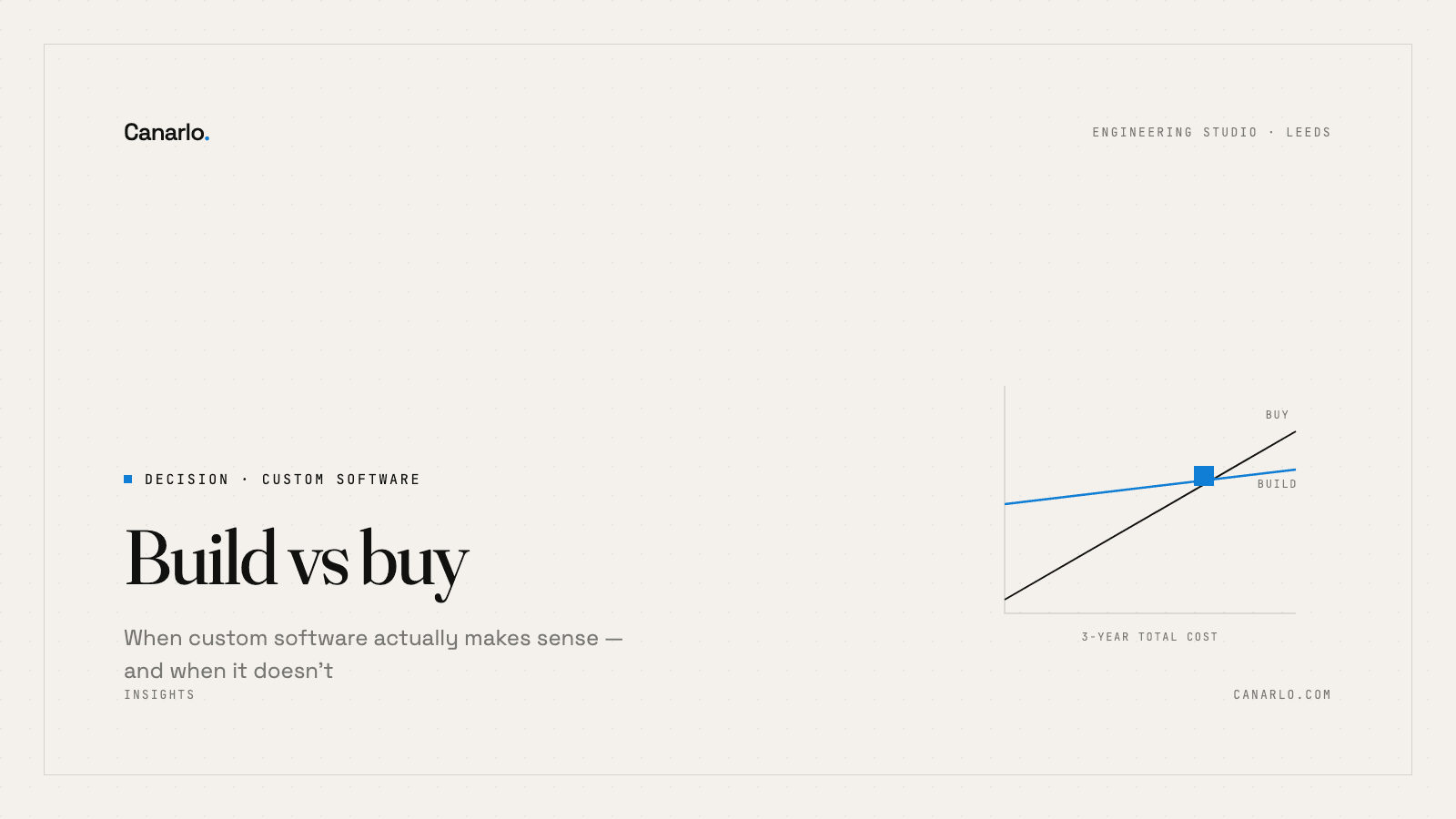
Subscriptions look cheap because you pay monthly. Custom looks expensive because you pay up front. Both framings are misleading. The number that matters is the total cost over three years — including the cost of the tool not doing what you need.
| Off-the-shelf (SaaS) | Custom build | |
|---|---|---|
| Up-front cost | Low (setup, onboarding) | Higher (£3k–£25k+ depending on scope) |
| Ongoing cost | Per-seat, every month, forever | Hosting + occasional changes |
| Cost trajectory | Rises with headcount and usage | Roughly flat once built |
| You own | Nothing — you rent access | The code and the data |
| The hidden cost | Workarounds, manual glue work, lock-in | Maintenance, if neglected |
For a small team, a £40/seat/month tool is a bargain. For a 25-person team paying for three overlapping tools plus a person whose job is copy-pasting between them, the maths flips. The crossover point — where owning beats renting — usually arrives through headcount, usage, or the accumulating cost of the manual work the tools don't cover.
When buying is the right answer
We will tell you not to build if:
- The tool already does 90% of it. Bending your process to fit a good tool is almost always cheaper than building your own. Adopt the tool's way of working and move on.
- The workflow is standard. Invoicing, scheduling, basic CRM, email marketing, helpdesk. These are solved problems. Buying gets you a better product than you could justify building.
- You haven't validated the need yet. If you're not certain people want the thing, don't build it. A £20/month tool or a spreadsheet is the right way to find out.
- You need it live this week. Custom takes time. If the bleeding is now, stop it with a tool now.
When building starts to make sense
Building earns its cost when:
- The thing you need doesn't exist, or every tool that does it makes a tradeoff you can't live with.
- The workflow is your differentiator. If a competitor could buy the same tool and run your business, that tool isn't your edge — it's table stakes. Custom is where you encode the thing they can't copy.
- You're paying to fight your tools. Per-seat fees climbing past what a build would cost, plus the salary of whoever maintains the workarounds, is a build waiting to happen.
- Lock-in has become a real risk. When a vendor owns data you can't export, prices you can't influence, or a roadmap that's drifting away from you, owning the thing buys back control.
The decision, in one table
| If… | Then |
|---|---|
| The workflow is generic and a tool covers it | Buy. |
| You haven't proven anyone wants it | Buy or fake it — validate before you build. |
| A tool covers most of it but you bridge the gap by hand | Buy + a small custom layer — automate the glue, not the whole thing. |
| The workflow is your edge and no tool fits | Build. |
| Tool costs (fees + manual work + lock-in) now exceed a build | Build. |
The most common mistake isn't building too rarely. It's building too early — replacing a £30/month tool with a £15k system before anyone has confirmed the workflow is worth keeping. Validate with the cheap thing first. Build the expensive thing once you know exactly what it has to do.
The middle path most people miss
It's rarely all-or-nothing. The highest-leverage option is usually a thin custom layer over tools you keep: a small integration that removes the copy-paste between two SaaS products, an automation that handles the handoff a human does today. You keep the mature off-the-shelf products and build only the 10% that's yours. Cheaper than a full build, and it leaves you with something you own at the exact point it matters.
One last thing
Owning software is a commitment, not a trophy. A custom build you neglect rots faster than a SaaS subscription you forget about. Only take ownership of the parts of your business that are worth maintaining — and let someone else carry the rest.
If you're weighing a build and want a straight answer about whether it's worth it, book a call — no pitch, just an honest read on build vs buy for your situation.