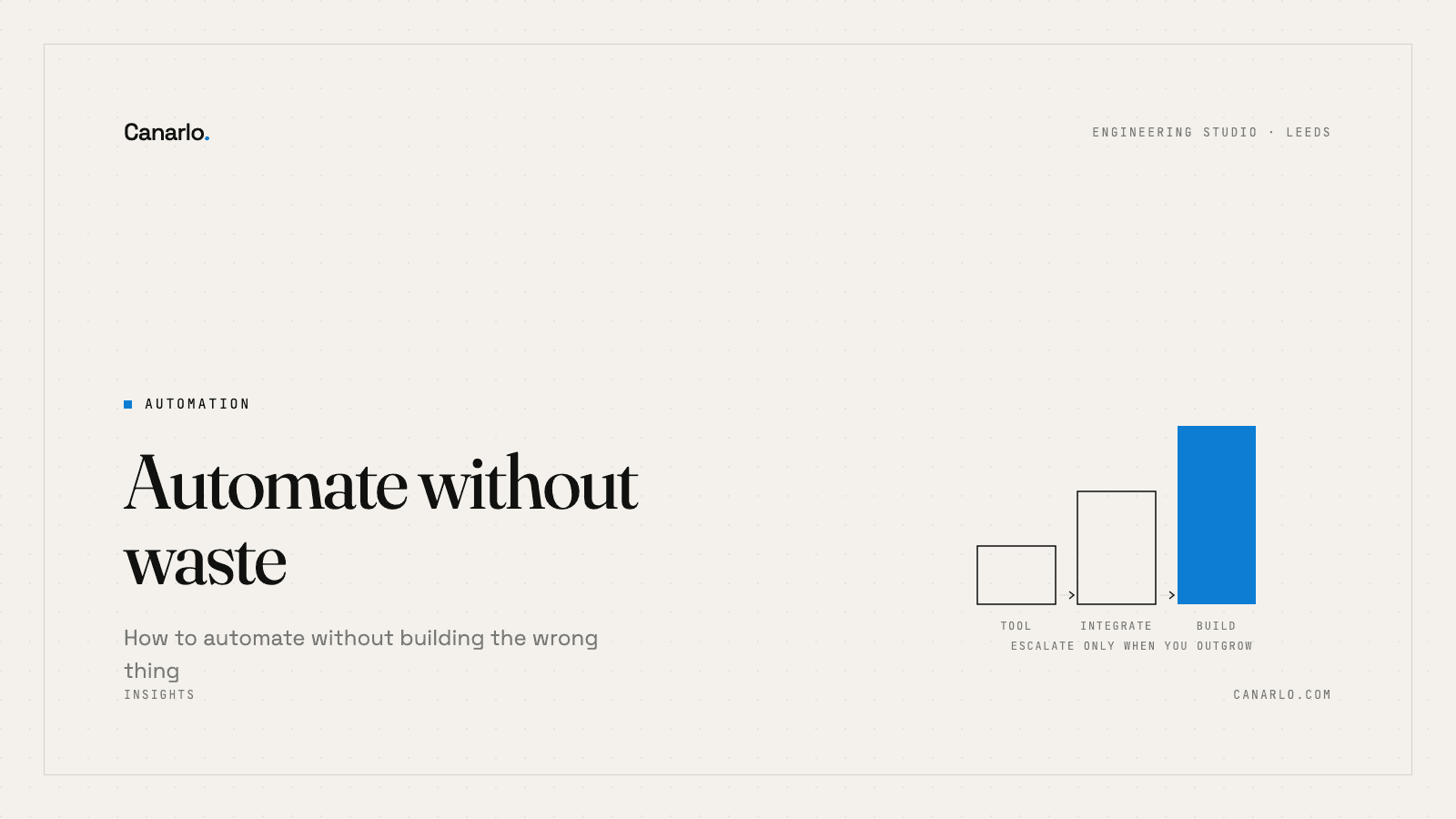
Automate in the cheapest way that works, and only move up when you've genuinely outgrown the step below. That means: buy a tool first, wire tools together with something like Zapier second, and build custom third — last, not first. Most automation money is wasted by jumping straight to a custom build before anyone has proved what the automation actually needs to do.
The three rungs, in order
Think of automation as a ladder. You climb it one rung at a time, and you only climb when the current rung stops holding you.
| Rung | What it is | Good for | Roughly |
|---|---|---|---|
| 1. Buy a tool | An off-the-shelf product that does the job | Standard, common workflows | £-tens/month |
| 2. Integrate | Zapier, Make, n8n connecting tools you already use | Gluing 2–4 apps together | £-tens to low hundreds/month |
| 3. Build | A custom automation you own | Logic no tool handles; high volume | from ~£3k, one-off |
The mistake almost everyone makes is skipping straight to rung 3 because it sounds like the "real" solution. It usually isn't — not yet.
Rung 1: Buy the tool
Before automating anything, check whether a product already does it. Scheduling, invoicing, email sequences, helpdesk routing — these are solved. A good tool is cheaper, more reliable and better maintained than anything you'd build for the same job. If a tool covers it, you're done. Don't automate what you can simply buy.
Rung 2: Integrate what you've got
Most "we need automation" problems are really "our tools don't talk to each other" problems. The fix is an integration platform — Zapier, Make, n8n — wiring your existing apps together: a new order triggers an invoice, a form fills a spreadsheet and pings the team, a signed contract starts onboarding.
This rung is where the majority of small businesses should live. It's fast, it's cheap, it's changeable, and — this is the important part — it shows you exactly what the automation needs to do. Every Zap you build is a free specification for the custom version, if you ever need one.
Rung 3: Build custom — but only now
Custom is the right rung when you've climbed the first two and hit their limits. The signs are specific:
- Volume. Per-task pricing on Zapier is cheap at hundreds of runs and painful at hundreds of thousands. At scale, owning the automation is cheaper.
- Logic. The decision your automation needs to make is too involved for a visual builder — real branching, real calculation, real judgement.
- Fragility. Your chain of Zaps has become a tower of workarounds that breaks when any one app changes, and no one's quite sure how it all fits together.
- Reliability. This workflow is now business-critical and a silent failure costs real money, so you need proper error handling, logging and ownership.
When two or more of those are true, building is no longer premature — it's overdue. And because you've already run it on rung 2, you know precisely what to build. That's the difference between a custom automation that pays for itself and one that gathers dust.
The one mistake to avoid
Building before validating. It's tempting to commission a polished custom system on day one because it feels decisive. But until a workflow has actually run — until you've watched the edge cases, the exceptions, the "oh, except when…" — you don't yet know what the right automation is. Build it then and you'll build the wrong thing, expensively. Run it cheap first, learn what it really needs, then build the version you'll keep.
This is why we'll often tell a prospect to spend a fortnight on Zapier before spending anything with us. If it holds, great — you've saved the build. If it breaks in instructive ways, you've just written the brief for a custom automation that works on the first try.
One last thing
The aim isn't "automated". It's less manual work for less money, with fewer things that can break. Sometimes that's a £20/month tool. Sometimes it's a custom build. The skill is knowing which rung you're on — and not paying for a higher one until the one below has actually run out.
If you've outgrown your tools and the Zaps are starting to creak, that's the right time to talk. Book a call — no pitch, just a straight read on what's worth automating and how.