Most of what gets sold as "AI for your business" in 2025 is a chatbot wrapper around GPT. It looks impressive in a demo. It often doesn't work reliably in production. Understanding the difference between that and a properly integrated AI system is worth about 10 minutes of your time before you spend money on either.
The two things people call "AI"
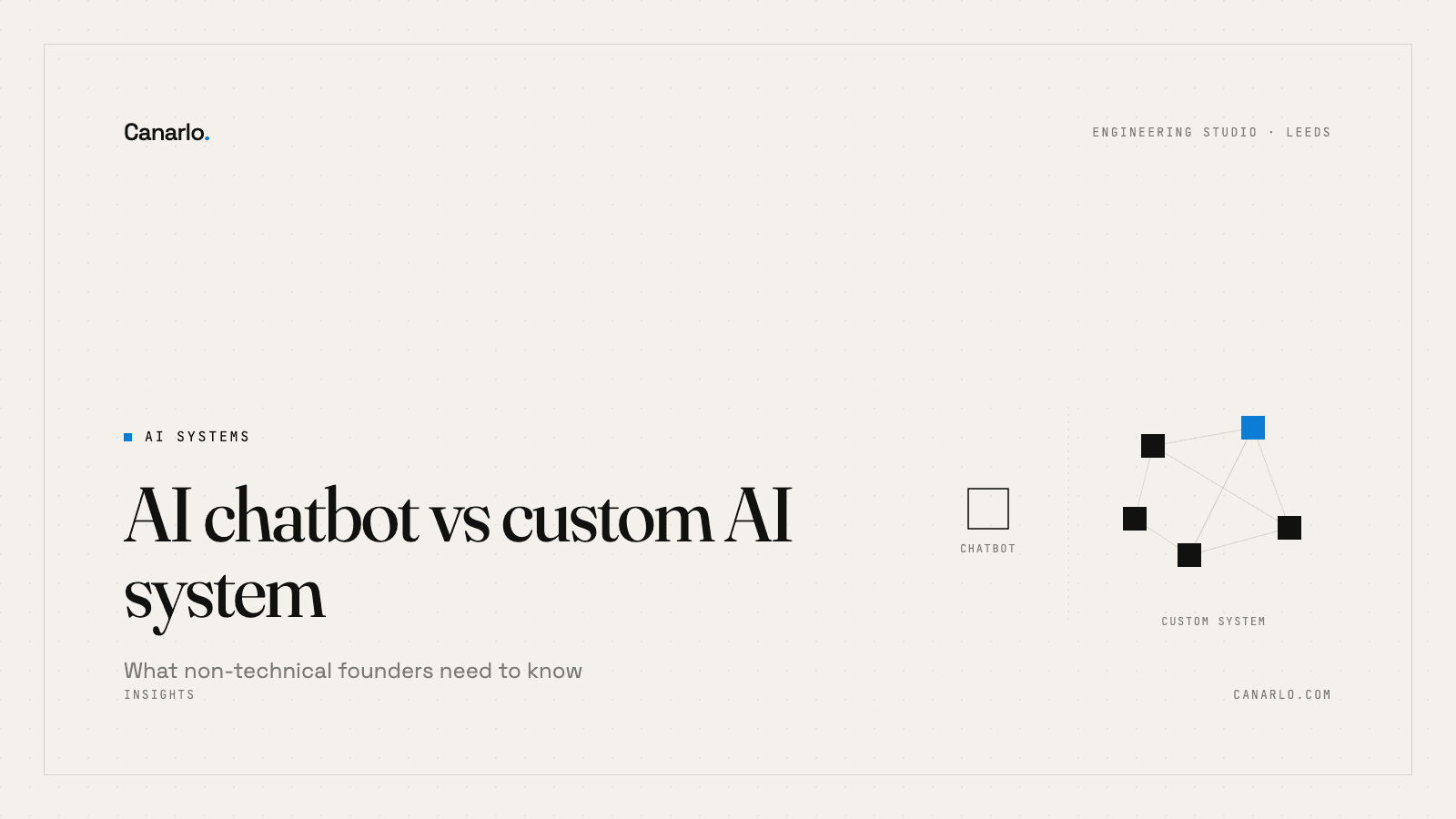
A chatbot wrapper is a chat interface connected to a large language model (usually GPT-4 or similar). Someone builds a box on your website, gives it some instructions about your business, and now it answers questions. Takes a few hours to set up. Costs £50–£500 to build, plus API costs per query.
A workflow-integrated AI system uses the same underlying models — but connects them to your actual data, your actual processes, and your actual tools. Instead of just answering questions, it does work: extracts structured data from documents, routes enquiries based on content, drafts outputs that feed into your existing systems, flags anomalies in a feed of records.
The distinction isn't the AI itself. It's what the AI is connected to, and what it's actually being asked to do.
What a chatbot demo hides
Chatbot demos are easy to make impressive. You give the model a well-written system prompt and a clean example question, and it responds correctly. Looks like magic.
The problems appear at scale, under real conditions:
Hallucination. Language models generate plausible-sounding text, not necessarily accurate text. A chatbot told "here is our pricing" can still misquote it under certain phrasings. For low-stakes conversations this is fine. For anything involving contracts, compliance, or medical information, it's a liability.
No memory. A standard chatbot wrapper doesn't know what happened last week, doesn't remember the conversation from yesterday, and has no idea what's in your CRM. Each conversation starts cold.
No action. A chatbot can tell someone how to raise a support ticket. It cannot raise the support ticket. The gap between information and action is where most chatbot projects stall.
Fragility to edge cases. In a demo, the questions are cherry-picked. Real customers ask things nobody anticipated. A chatbot without careful testing fails oddly — confidently, but wrongly.
None of this means chatbots are worthless. For FAQ deflection on a high-volume support site, they're genuinely useful. The question is whether the problem you're trying to solve actually needs a chatbot, or whether it needs something that does real work.
What makes AI genuinely useful in a business
The AI applications that actually deliver value share a few characteristics:
They are connected to real data. Not a generic model responding to general questions — a system that can look things up in your database, read a document you've just uploaded, or pull from your order history.
They reduce a human step, not add one. The best AI implementations remove friction from a process a human was already doing. Not "chat with our AI assistant" but "this document arrives, the AI extracts the key fields, they land in your spreadsheet — no manual entry."
The output is verifiable. You can check if the AI got it right, and the cost of being wrong is manageable. Data extraction is a good fit. Autonomous decision-making on important matters is not.
They run on a schedule or trigger, not just on demand. A webhook fires, an email arrives, a form submits — the AI processes it and routes it. No one has to click a button.
Where AI is not worth it (yet)
Be honest with yourself about this. AI is not a good fit when:
- The process requires real judgment based on context the model can't access
- The cost of errors is high and errors are hard to catch
- The volume is low enough that a human does it faster
- You're trying to replace relationship work (sales calls, account management, complex negotiations)
- The underlying process is unclear — automating a broken process makes a broken process faster
There's a pattern in failed AI projects: the founder saw a demo, got excited, hired someone to build the same thing, and discovered the demo worked because the demo was designed to work. If someone is selling you AI and they can't explain where it will fail, ask harder questions.
The honest case for a £3k automation sprint
Canarlo's AI & Automations sprint starts at £3k. That's not a chatbot. Here's what it actually is.
A sprint is a short, tightly scoped engagement — typically two to four weeks — focused on one workflow. We identify something you're doing manually that has consistent inputs and predictable outputs, then build a system that handles it automatically.
Common examples:
- Inbound enquiries classified, summarised, and routed to the right person — without anyone reading them first
- Documents (invoices, applications, contracts) parsed and key fields extracted into a spreadsheet or database
- A daily data feed checked for anomalies, with a summary emailed to you only when something needs attention
- A CRM field auto-populated based on email content
The reason £3k is viable for real work (not just a chatbot) is that we've built the infrastructure components before. We're not starting from scratch on authentication, prompt engineering, error handling, and API integrations. We apply that to your specific workflow.
What you need to bring: a clear problem, real examples of the inputs (10–20 representative samples), and a definition of what good output looks like. We'll tell you quickly whether the problem is a good fit.
What you won't get for £3k: a general-purpose AI assistant, a custom LLM, anything that requires training on your data (fine-tuning), or a system that replaces a complex multi-person process. That's a different scope and a different conversation.
Questions worth asking before any AI project
Before you spend money with anyone — including us — ask these:
- What does the system do when the AI gets it wrong? Is there a fallback?
- Where will it fail? (Any honest vendor will have a clear answer to this.)
- What data does it need access to, and how will that access be secured?
- How do I know if it's still working in three months?
- Who owns the code and the workflow when the engagement ends?
AI projects fail most often not because the AI was bad but because the brief was unclear, the failure cases weren't designed for, and no one was watching it after launch.
Summary
| Chatbot wrapper | Workflow-integrated AI | |
|---|---|---|
| Build cost | £50–£500 | £3,000–£15,000+ |
| What it does | Answers questions | Does work |
| Connected to your data? | Rarely | By design |
| Reliable in production | Hit and miss | Designed to be |
| Best for | FAQ deflection, low-stakes chat | Document processing, routing, automation |
| Worth it when | Volume is high, stakes are low | A human is doing this manually right now |
If you have something repetitive and rule-shaped that a member of your team does every day, there's a good chance AI can handle it. If you want a chatbot on your website because it looks modern, save the money.
Book a call if you want to talk through a specific workflow. We'll tell you whether it's a good fit in 20 minutes.